We use Cookies. Read our Terms
The OPEC Fund and Africa: Partnership in action
Deepening cooperation with the African Development Bank paves the way for new engagements in projects and programs
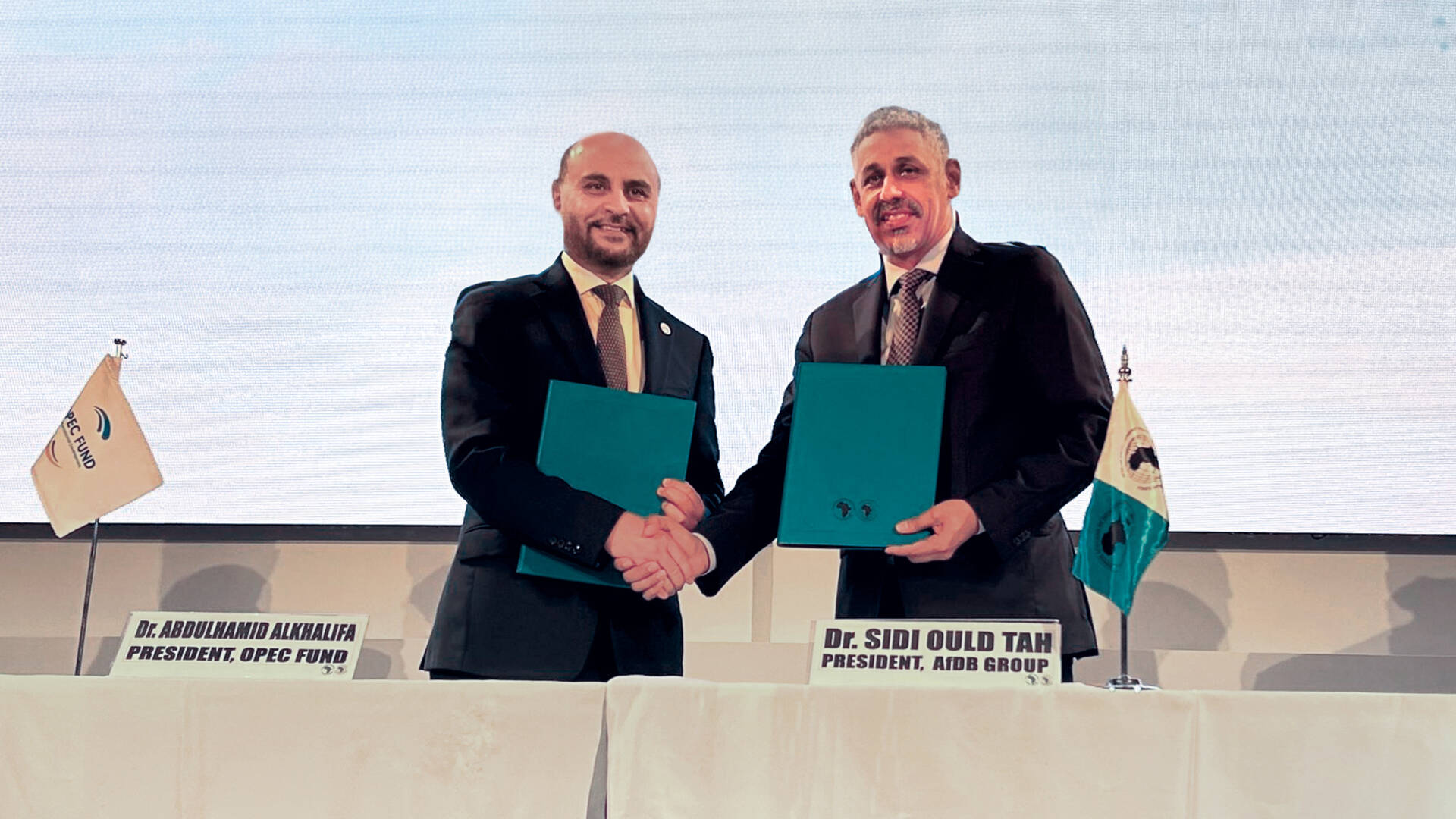
The OPEC Fund is intensifying its engagement in Africa. New commitments set a record in 2025 with US$1.5 billion for projects across the continent and across all key sectors. Intensifying engagement also means deepening cooperation with development partners.
A key step in this direction was taken in January 2026 when OPEC Fund President Abdulhamid Alkhalifa signed an amendment to the existing Memorandum of Understanding with the African Development Bank (AfDB) on strategic cooperation. The agreement, signed for AfDB by President Sidi Ould Tah, deepens the framework for collaboration across public and private sector operations, co-financing and knowledge exchange.
The cooperation between the OPEC Fund and AfDB started in 1978 and to date some 120 joint public and private sector operations have been approved, covering projects across energy, transport, agriculture, water and social infrastructure, together exceeding US$1.5 billion. In addition to project financing, the two institutions are also working together on large programs such as Mission 300, which aims to connect 300 million people in Sub- Saharan Africa to electricity by 2030.
President Alkhalifa said: “Africa remains central to the OPEC Fund’s mission. Our partnership with AfDB continues to evolve into a more strategic and impact-driven collaboration, focused on accelerating delivery and supporting country-led development priorities. By working more closely together, we can scale solutions and deliver stronger results for people and communities across the continent.”
Intentions were immediately translated into action, as the OPEC Fund – together with the Trade and Development Bank Group (TDB) – joined the Alliance for Special Agro-Industrial Processing Zones (SAPZ), which aims to pool finance, technical expertise and private sector participation to scale agricultural value-chain development across the continent.
Through coordinated financing, shared infrastructure, targeted incentives and structured value chain linkages, SAPZs enhance competitiveness, reduce investor risks and attract sustained private capital. They are central to Africa’s agricultural transformation, bridging rural and urban economies by linking smallholder farmers to structured value chains, processing facilities and consumer markets.
Under the SAPZ alliance, the OPEC Fund and TDB Group will work with existing members to mobilize blended finance and catalytic capital, support project preparation and risk-mitigation tools, strengthen value chains and accelerate job creation and rural industrialization. President Alkhalifa noted that the objectives were fully aligned with the OPEC Fund Food Security Action Plan and added: “This partnership is a strategic opportunity to accelerate sustainable agricultural and agribusiness development across Africa.”
Another milestone in the cooperation with AfDB was a high-level consultation with the Arab Coordination Group (ACG), an alliance of 10 development finance institutions including the OPEC Fund. AfDB President Tah has long welcomed “a more structured and entirely strategic partnership.”
The consultation ended with a “joint declaration on strategic partnership,” launching a new phase of cooperation and paving the way to a Financing and Operational Partnership Framework. Set to be elaborated in 2026, this plan will define options for co-financing, pipeline coordination, mutual reliance and regular joint programming.
The ACG is one of the largest supporters of African development. The group’s cumulative financing on the continent exceeds US$220 billion over the last five decades. In November 2023, the 10 ACG members pledged US$50 billion in investments with an emphasis on energy, climate mitigation and adaptation, food security, regional integration and private sector financing.
OPEC Fund President Alkhalifa said: “Faced with the decisive transitions Africa is facing, development banks have to be prepared to work together more closely, not only in financing but in implementation. This is why we are scaling up our engagement. Our objective is not simply to increase volumes, but to support these transitions in a way that is practical, coordinated and focused on results.”