We use Cookies. Read our Terms
Mission Senegal: “The key is how you manage your resources”
A visit to the West African country enables an OPEC Fund team to deepen a long-standing development partnership
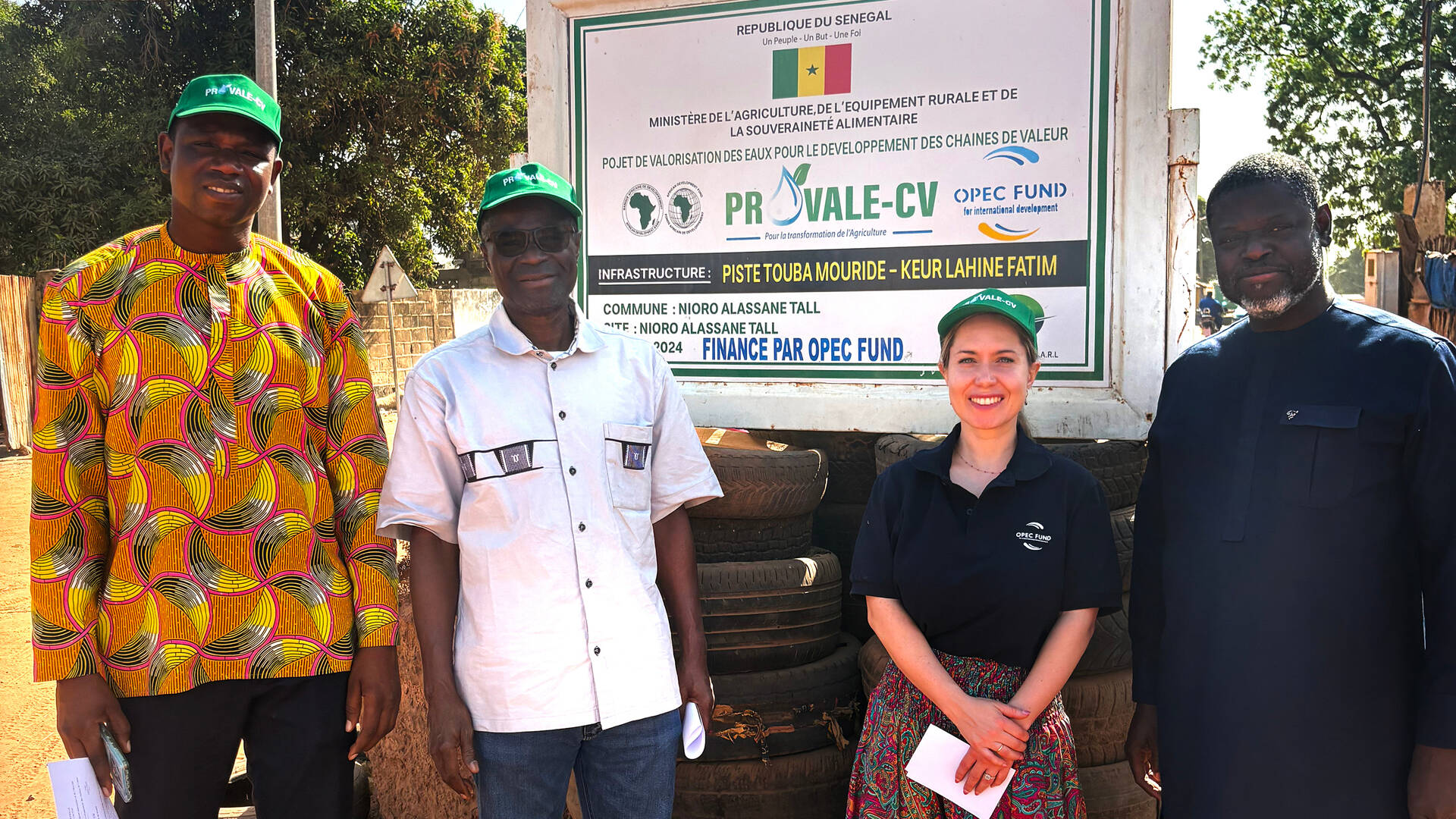
When it rains, it pours. In the rainy season – June to October – Senegal is frequently exposed to heavy flooding, while in the dry season – November to May – the country faces chronic water shortages. Water management is therefore critical for the West African country, which faces an additional challenge in some coastal areas: water usually flows back to the sea, but because of the low incline it seeps back into to the land during the dry season’s high tides. As it is now contaminated with salt, the water makes the soil unusable for agriculture.
The Water Valorisation for Value Chains Development Project (PROVALE–CV), co-financed by the OPEC Fund with a US$20 million loan signed in 2020, addresses this issue with a far-reaching infrastructure development program. A recent mission to Senegal provided Mourad Bouaouina, Director, Portfolio Management Unit, Public Sector Operations, and Valentina Walden, Portfolio Manager, Public Sector Operations, with the opportunity to witness firsthand the delivery of this and other projects.
They found that simple, yet ingenious solutions are often the best: “Our partners have built small dikes, 1-2 meters high, that allow excess water during the rainy season to flow to the ocean but prevent the returning saltwater from going back upstream during the dry season,” explained Mr. Bouaouina. “This protects the arable soil from salt, while the collected water can be used in irrigation.” Prudent water management is particularly important in a country which, according to the United Nations Development Programme (UNDP), is “highly vulnerable to climate change.”
With a total cost of US$136 million and co-financed by the African Development Bank (AfDB) and other partners, the program included a modernization and overhaul of the agricultural infrastructure across eight regions, as well as investments in value chains and youth entrepreneurship. Once the program reaches its full potential, it is expected to substantially increase domestic production, enabling the country to achieve greater self-sufficiency in agricultural products and enhance its capacity to feed its entire population.
“With the dam, there is a clear difference between yesterday and today. Our production has tripled or even quadrupled. We are now able to meet our rice needs and sell part of it,” said Issa Cisse, the Deputy Mayor of Bogal, a settlement in the Sédhiou region in the southwest of the country, after the construction of a 450 meter retention dam.
The project has made a significant contribution to strengthening food security. “The impact has been huge,” said Ms. Walden. “It changed how people manage their land, what they plant and how they harvest.” The rich yields have even opened up the opportunity to sell produce abroad: “We met farmers who are growing vegetables of such quality that they are now exporting to Switzerland,” she added.
Furthermore, the project has financed the construction of several rural access roads. Sylvain Diatta, President of the Federation of Banana Producers of Balantacounda, a local producer organization representing smallholder farmers, said of its local road: “This has been a long-standing request. Its construction now allows us to transport our produce much more easily.”
The overall results have been impressive: Of the 12,000 ha arable land developed under the program, about a third was recovered thanks to salinization control. The project benefited 38,000 households with about 300,000 people. Idrissa Haïdara, a returning migrant and beneficiary of a mixed-crop farm, said: “The achievements of PROVALE-CV have taken us to another level. Before, during certain periods, I had to go far away with my donkey to fetch water to irrigate my crops so they wouldn’t dry out. Today, I am running a commercially successful papaya production.”
Because of the program’s accomplishments, a second phase has been agreed. The OPEC Fund approved a US$25 million loan in 2025, with signing pending. The benefits go beyond agriculture. Mamadou Mané, President of the Kakatan Cooperative in Sédhiou, underlined: “With these developments, our youth now have enough to live better here instead of going out to sea trying to cross over to Europe.”
The OPEC Fund’s cooperation with Senegal dates back to a first balance of payments support loan signed in February 1977. Over the years, the OPEC Fund has provided close to US$700 million in public sector and US$45 million in private sector loans, as well as more than €260 million in trade finance. The main sectors of engagement are agriculture and transport infrastructure. At present, eight projects are ongoing, of which five are expected to be completed by the end of 2026.
Mr. Bouaouina served as Country Manager for Senegal from 2014 to 2023. He praised the country’s development progress and strong sense of taking its destiny into its own hands: “We can clearly see that the country is moving forward.”
One factor, he said is decisive for a successful project: “I have been in this business quite a bit and from what I have seen, it is not just finance that makes a project succeed. It’s the human being who is managing this resource. This is crucial. I have seen countries making very little out of a lot of financing, and others who made a lot out of very little. The key is how you manage your resources.”
Through its activities in Senegal, the OPEC Fund has its finger on the pulse of the country’s needs. A major challenge is rapid urbanization. The metropolitan area of the capital Dakar, with 3.8 million inhabitants, is home to more than a fifth of the country’s population – yet covers just 0.3 percent of the state’s territory. According to the UN, the country’s urban population has grown from 23 percent in 1960 to over 50 percent in 2024.
One response must be “to enhance living conditions outside urban areas,” Mr. Bouaouina said. Better transport infrastructure is an important way to connect rural areas with the cities, facilitate the flow of goods and open up business opportunities. Senegal is now building a 200 km highway between Dakar and Saint Louis, an industrial hub in the north of the country.
Alongside the OPEC Fund, fellow members of the Arab Coordination Group, AfDB, as well as several West African institutions are involved in this major highway project: “Our lot is 95 percent finished,” reported Ms. Walden. “I am impressed by the quality of the work done,” added Mr. Bouaouina.
Here again strong leadership, close relationships and constant monitoring are key: “There is not a single day in the office when I am not on the phone to teams on the ground,” Ms. Walden said. A truly special relationship.