We use Cookies. Read our Terms
Book review: When all the world goes bananas
Vaclav Smil breaks down the complex world of food, agriculture and nutrition into the easily digestible "How to Feed the World"
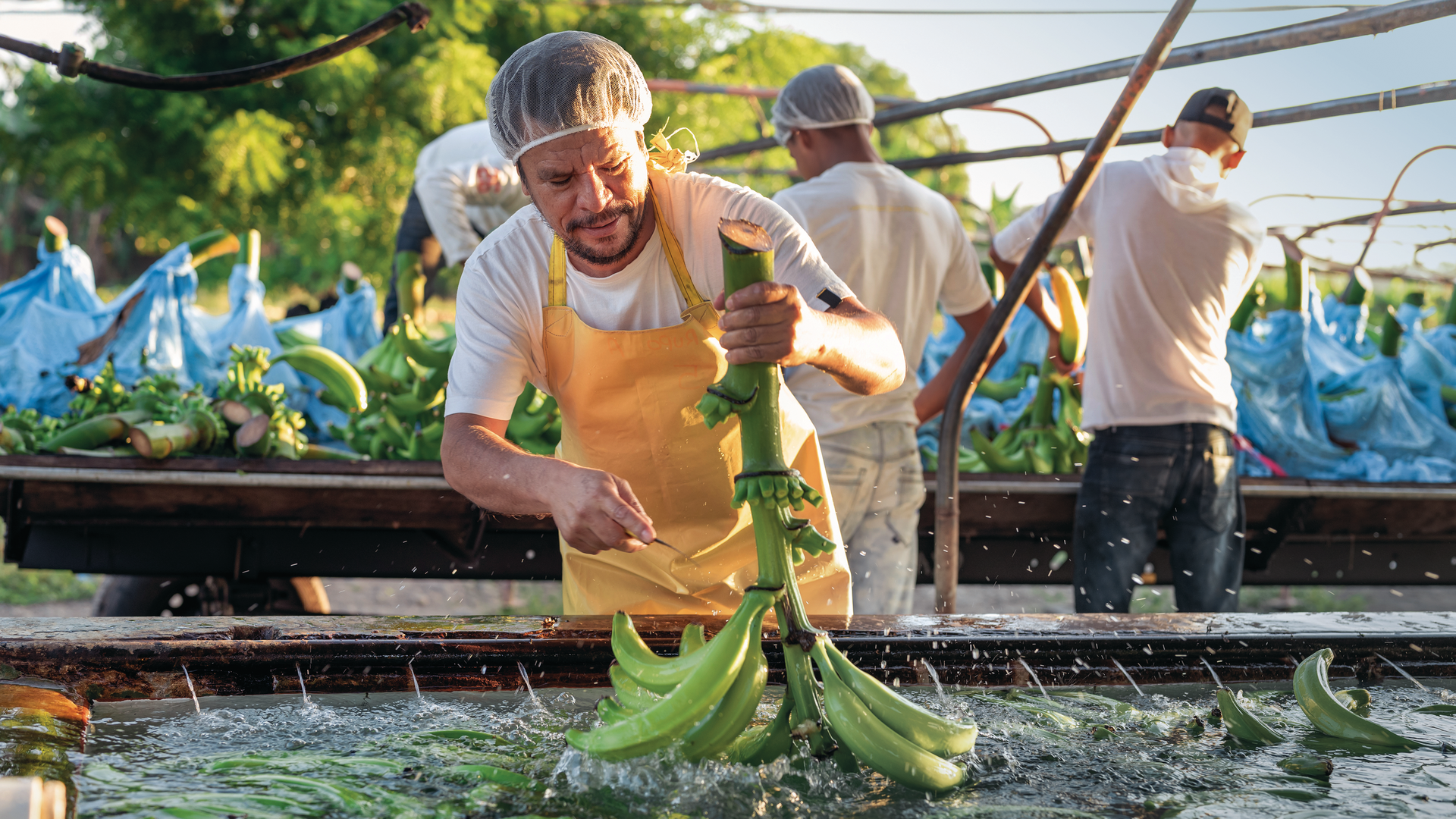
Photo: SALMONNEGRO/Adobe Stock
How to Feed the World: The History and Future of Food
Vaclav Smil
Viking, 2024, 262 pages, ISBN 978-0593834510
It could be more than a fig leaf. One can imagine a fad, no-fat, no-protein “all-natural” Chimp Diet that emerges in a few years consisting of little more than figs. Chimpanzees, these medium-sized great apes and our closest living relatives, get roughly 80 percent of their food energy from figs and other fruits and berries. Insects and scant bits of meat provide trace amounts of protein. Were humans to try this, it would take at least 4 to 5 kilograms a day to satisfy the necessary calories… and you’d have to spend most of your day eating.
Put another way, if everyone in the European Union were to move to an all-fig chimpanzee diet, it would require about 400 times the current global production of figs. Imagine the titanic shift a fig-centric agriculture industry would have to take and it’s quite easy to see why such a diet would never be feasible on a broad scale.
The chimp question comes up early in Vaclav Smil’s recent book How to Feed the World, though it is hardly the focus of a title that asks other seemingly simple questions and then provides thorough, academic answers that are rarely difficult to understand. With chapter titles like, “Why Do We Eat Some Animals and Not Others?” and “What’s More Important: Food or Smartphone?” you know you’re not getting an overly technical or stuffy survey of the global food ecosystem, but a primer for a general audience that goes down easy while still being nutritionally fortified.
The book’s subtitle, “A Factual Guide,” is a clue to its tone and structure. One might assume that an interdisciplinary professor with more than 50 books and hundreds of academic articles under his belt won’t be easy to understand, but Smil’s book resembles the iceberg theory of writing (not the lettuce): there’s a bit of text on the page itself, but there is much more under the surface supporting it.
Each of the many sub-topics explored in the book’s eight chapters lasts roughly a page, yet one can imagine that the four or five paragraphs can easily be spun out into their own distinct chapters, especially when introducing concepts such as FIFO, the fish-in/fish-out ratio. (In aquaculture, FIFO is used to measure the number of tons of wild fish, in the form of fish feed, it takes to produce a ton of farmed fish. One recent estimate puts the global FIFO ratio at 5:1.)
This big picture approach is what Smil, a Distinguished Professor Emeritus in the Faculty of Environment at the University of Manitoba in Winnipeg, excels at. He is a prolific author, having written about a wide range of subjects such as manufacturing, oil, the history of technological innovations and several books that show how a single topic (numbers, size and most recently, speed) can explain how the world works. Food is a recurring topic in Smil’s bibliography, having written books about Japanese diets, carnivory and the environmental effects of harvesting, just to name a few. He often spins out scenarios to their logical conclusion, which is best on display in the book’s most interesting segments on what an ideal diet would look like (and consequently, the resources needed in order to achieve this on a global scale). First, a wide adoption of a red meat-heavy “paleo” diet like the one plugged by U.S. Secretary of Health Robert F. Kennedy, Jr. and those in his Make America Healthy Again movement would raise the required animal slaughter by several factors (currently global meat production supplies only 8 percent of all food energy; paleo diets sometimes call for 40 percent of your calories coming from meat). Besides the mountain of meat needed, there’s a mountain range of grain and land needed to grow that meat (recall the FIFO ratio).
Relatedly, banking on cultured (i.e. lab-grown) meat as a way to save the environment still requires much research and investment, not to mention the dramatically large amount of energy it requires when compared to traditional ways of raising livestock. Even if that requirement was brought down, scaling up the nascent cultured meat industry to a global level comes with its own set of unknowable challenges.
On the flip side, Smil plays out the unrealistic world we would live in under a mass-adoption of veganism, especially for its seemingly environmental friendliness. Carbohydrates are not much of a challenge, but high-quality proteins would be. Yes, grain legumes such as beans would fill this role, but for that to happen, consumption (and the requisite, sometimes energy and water-intensive production) would need to go way, way up. In the end, it is the balanced, moderated diet that wins out, nutritionally, economically and environmentally. Ever the scientist, Smil is careful to point out that future scientific discoveries can change the viability of any sort of diet or industry.
The book also puts the value of food itself in perspective, comparing it to the valuation of a smartphone. Such a comparison might seem absurd until Smil picks apart all of the things that have to happen along the farm to fork supply chain and questions why, as important as it is, getting a banana shipped around the world and into a supermarket is somehow less expensive than shipping an iPhone from a factory overseas to a retail shop. Yet a world where all those bananas went away would be vastly more dire than one where all the iPhones went away. As is the practice throughout the book, a simple thought experiment (imagine life with no smartphones compared to life with no food) frequently leads the reader to a “well, I never thought about it like that” conclusion.
That’s not to say the points the book makes are overly simplistic or stuffy. When dismantling the argument put forth by some anthropologists and historians that agriculture itself led humanity to centuries of warfare and tyranny, Smil deadpans, “perhaps wheat is also responsible for all atrocities and natural disasters.” Elsewhere when refuting the claim that wheat consumption impacts longevity, he asks, “are the debilitating health effects of the finest Italian flour counteracted by climate or language or different hand gestures?”
So, how do you feed the world? As Smil repeatedly points out through the book, reducing food waste is a start. “Global food production now averages about 3,000 kcal per person; daily global food waste is about 1,000 kcal per person,” he writes. “And yet there is no urgency about changing that. If you were, constantly, losing a third of your income, you’d try to do something about it.” Recognizing that animal protein is not going away anytime soon (and that replacing it with fruits and nuts may not be any better for the environment), Smil is a proponent of shifting from energy, grain and water-intensive red meats, especially beef, to ones that use much less of all those things, such as chicken.
Now there’s something to chew on the next time you read a restaurant menu.