We use Cookies. Read our Terms
Africa’s Green Energy Future Must be Written on African Terms
The success of the energy transition should be measured by its ability to generate shared prosperity
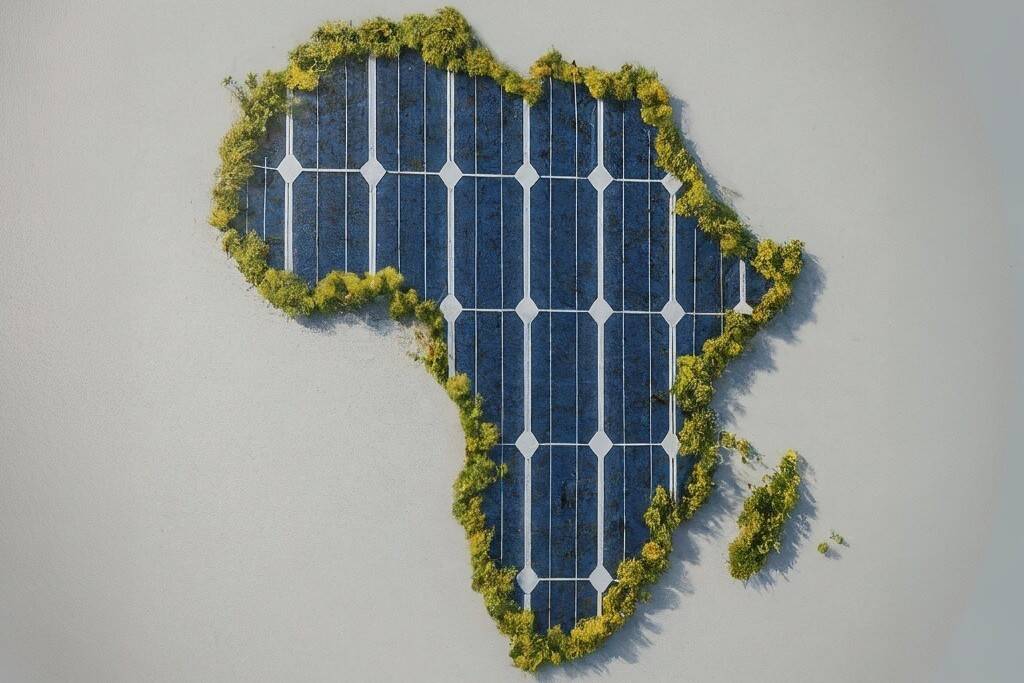
Image: Shutterstock AI
Across Africa, the expansion of renewable energy technologies is widely seen as a pathway toward sustainable development. Solar and wind projects are spreading rapidly, supported by climate finance and growing global commitments to decarbonization.
In countries such as South Africa and Kenya, the rollout of renewable energy has become central to energy planning and economic strategy. Yet the transition to green energy raises an important question: Will it also be just?
The transition provides an opportunity to replace fossil fuel systems, contributing to global climate targets such as the Paris Agreement, while also creating job opportunities. Yet such narratives often prioritize speed and efficiency to meet targets and grow sectors – overlooking who the transition is designed for, who is included in shaping it and ultimately who owns, controls, funds and benefits from these green technologies.
Because technological deployment alone cannot guarantee equitable outcomes such as access, fairness, decent work and sustainability, these outcomes are influenced by institutions. The lack of deliberate, justice-centered institutions risks reinforcing Africa’s dependency on the Global North while deepening existing inequalities.
Africa needs to redefine its innovation policy for a just transition by focusing on local industrial growth, inclusive skills development and local ownership to prevent the recurrence of past inequitable, extractive practices. The energy transition must be more than a technological change; it should involve a deep reorganization of power dynamics, production capabilities and social equity.
Green technologies, jobs and local industrial development
Across the continent, countries are expanding their clean energy infrastructure. South Africa, for example, is doing this through its Renewable Energy Independent Power Producer Procurement Programme (REIPPPP). As of 2026, Kenya generates nearly 90 percent of its electricity from renewable sources, with significantly increased capacity from solar and wind power, according to the International Energy Agency.
But industrial gains remain elusive as many countries are still heavily dependent on imported technologies, such as solar panels, wind turbines and battery components that are manufactured abroad, limiting opportunities for domestic manufacturing and capability development.
Green technology projects are often funded by international capital, developed by foreign firms and integrated into global value chains where domestic policymakers exercise little control. Most projects initiated in Kenya are funded by international donors because local stakeholders often face high upfront costs, including import expenses that hinder cost-effective renewable energy production.
African countries find themselves in a paradoxical position: Exporting critical minerals while importing technologies built from them, thus maintaining dependency. To change the current landscape, governments must intentionally develop and fully commit to innovation policies that align with their energy and industrial policies. This means incentivizing local firms to acquire technological capabilities, implementing procurement strategies that promote local manufacturing, facilitating technology transfers and encouraging joint ventures, while strictly enforcing local content thresholds for goods, services and labor.
Critical to this approach will be maintaining effective political coordination, enhancing bureaucratic capacity and the courage to challenge entrenched domestic and international interests that benefit from the existing system. Without that political will, the expansion of renewable energy infrastructure may generate clean electricity without creating significant local industrial development or employment.
Because of limited manufacturing capacity in African countries, construction and installation jobs remain the main categories of renewable energy employment, as seen in the Lake Turkana Wind Power Project in Kenya that houses around 11 percent of the country’s installed capacity and provides low-cost energy to the national grid. However, construction jobs are often short-term while installation tasks are limited in scope. The main driving force behind structural change lies in manufacturing, engineering and research, along with the educational and skills development systems needed to support them. Unless countries prioritize anticipatory skills planning that matches their industrial goals, they risk training workers for jobs that will always be overseas.
Avoiding exclusion
As decarbonization accelerates across South Africa, coal-dependent communities face increasing economic uncertainty, while poor communities still suffer from regular blackouts. Kenya tells a different story with a similar experience; while it has made significant progress in its energy mix, rural communities remain underserved or priced out of the market. The need to address such challenges is reflected in the common phrase of the just energy transition, “leave no one behind”.
There is another stark divide between small and large firms, where established corporations, often with foreign ties, enjoy streamlined access to resources due to their size and influence. Local cooperatives, small businesses and community-led initiatives find themselves marginalized in the procurement process, sidelined in the ongoing energy transition. African countries thus struggle to define fair and independent strategies for the energy transition.
A key area of inclusion is the involvement of affected workers, rural communities or those historically marginalized in the transition process. Unless these groups are actively included, their exclusion is a predictable outcome. Sadly, the communities most at risk of being overlooked are those that lack the political influence to advocate for their inclusion. Justice requires substantive public participation and innovation policies deliberately designed to redistribute not only energy but also economic and political power.
How innovation policy can support fairness
Addressing these exclusions depends on how innovation policy is designed and by whom. Innovation policy serves as the institutional mechanism that connects green technology, job creation and justice. It shapes decisions on research funding allocations, the structuring of renewable energy auctions, the enforcement of local content requirements and the design of skills development incentives, among other aspects. By prioritizing local manufacturing, promoting technology learning and encouraging inclusive participation, innovation policy can ensure that the transition to renewable energy fosters meaningful structural transformation.
Innovation policy is itself political, shaped by bargaining between ministries, domestic and foreign investors, as well as labor and energy interests. In South Africa, this complexity is reflected in the tensions between labor movements and environmental advocates. In Kenya, the significant presence of international actors and reliance on their expertise have increased their influence over domestic policies.
A significant challenge many African countries face is a lack of coordination among ministries, leading to disjointed policies that fail to complement one another. To foster meaningful change, we must cultivate an inclusive and lasting alignment among diverse coalitions. Only then can we develop cohesive policies that not only address energy needs but also promote social equity and environmental sustainability.
An innovation policy that supports fairness in Africa should be intentionally developed, reflect regulatory credibility, allow for learning, relearning and adaptation as the world changes – while also investing in local capability building and African-led research. African governments need to boldly embrace innovation policies, civil society must be able to hold these transition strategies accountable and international partners should provide funding that fosters independence rather than perpetuating dependency. Without such deliberate institutional redesign, the transition will follow the same concentrating logic that has long defined the fossil fuel economy.
Owning the transition
A just energy transition presents a tangible opportunity for development, though it requires more than the deployment of green technologies. Deliberate efforts are needed to align innovation policy, industrial development strategies and social objectives. For Kenya, South Africa and the broader continent, the goal cannot simply be participation in the transition; it must be ownership of it. The success of the transition should be measured by its ability to generate shared prosperity, stronger communities and genuine political agency, rather than simply the share of green tech in the energy mix. Africa’s green future is still being written – this is the moment to author it on African terms.
Wandile Mlilo
Wandile Kelly Mlilo is a DPhil Innovation and Development student at the SARChI-Trilateral Research Chair in Transformative Innovation (TRCTI) at the University of Johannesburg. Her research focuses on the political economy of renewable energy innovation and transitions in Sub-Saharan Africa. Her research engages both the policy and socio-economic dimensions of energy transitions. She has worked on projects in renewable energy, local economic development and emerging digital technologies, developing social plans, impact assessments and exit strategies for coal power plants.